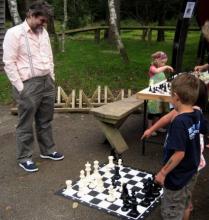
Genial Cornish giant Andrew Greet came to show us how it was done
before Christmas, and I'm sorry it's taken me this long to catch up and
do some notes.nbsp; Bob Jones was generous and prompt in his
transcription of the games to PGN, so please don't blame him!
Having watched Gary Lane wipe the floor with us a few times, I thought
I had a view about how it was done, but clearly personal style has a
bearing too: Andrew seemed much less inclined to go for broke and
played quite conservatively in the openings, content to go for a solid
Diligent explorers of this website may have found a little collection
of the finest swindles that I had perpetrated in my career, up to the
point where I established this website.nbsp; I pulled off another one
so appalling that I thought it too should be displayed as a dreadful
warning to others.nbsp; The serendipity of life ensured that a week or
two before, hot new signing Tim Paulden had pulled off a win when a
piece down in an endgame, and a week or two after, I witnessed Ian
Jamieson come out with a win in a position that the most sympathetic
reading would say was unpromising.
Well, ouch! We lost four-nil, but I hope you thought that, however
big and strong they were, they weren’t that much better than us, and
they didn’t do anything very special to beat us. (Is that a good
thing?) But I was very pleased and proud with how well you
played, how well you fought, and how well you concentrated. It
wouldn't have needed much luck for us to come away with 2-2.
They're just tall, that's all...
These are extracts from Simon Webb's superb series of articles for
Barry Wood's old CHESS magazine. Simon showed a panel of players a
position and recorded their spoken thoughts for ten minutes. The
articles are well worth digging out: obviously there is much more
in the articles than I can present here, but it will give you a
flavour of the sorts of issues that can arise. The joy of this
technique, of course, is that you can repeat the exercise with the
same or different positions in your own club.
The positions are presented twice, one without commentary
or, "the hardest thing to win is a won game" (TARRASCH).
36. Ne1?
"Well, well. IM (and correspondence GM) Douglas Bryson
once told me that he almost never plays a game that flows smmothly
from start to finish; there is always a "moment" of sorts where
someone misses a big defensive opportunity or the nature of the
position changes more than one might reasonably expect. This was
such a "moment"."
-- Jonathan Rowson British Chess Magazine October 1999 p.553